Skip to content



How to Match Disc Mower Width to Hay Rake and Baler Pickup Width Before You Buy
 Choosing a disc mower by cutting width alone can create problems later in the hay system. A mower may cut the field quickly, but if the hay rake cannot efficiently gather those mower passes—or the finished windrow is too wide or too heavy for the baler pickup—you may lose much of the efficiency you gained while mowing.
The best way to match disc mower width to hay rake width is to work backward from the windrow you want to feed into the baler.
As a practical starting point:
-
Size the disc mower to your tractor, acreage, crop, and field conditions.
-
Size the hay rake according to how many mower swaths you want to combine in one pass.
-
Adjust the finished windrow so it is no wider than the usable width of the baler pickup.
-
Reduce the number of combined swaths when heavy crop volume would overload the baler.
The important point is that mower cutting width, rake working width, windrow width, and baler pickup width are four different measurements. A well-matched hay system considers all four.
If you are still choosing the mower itself, compare the available cutting widths in the Farmry Disc Mower Collection. Farmry currently offers models including a 65-inch DHM6 and 81-inch DHM7, which make useful examples for understanding disc mower and hay rake size matching.
You can also compare the individual 65-inch Farmry DHM6 Disc Mower and 81-inch Farmry DHM7 Disc Mower before deciding how much rake capacity your hay system will need.
The Basic Width-Matching Rule
The simplest way to think about the system is:
Disc mower width → number of mower passes per rake pass → finished windrow width → baler pickup width
For one mower swath, the rake only needs enough effective working width to gather that swath cleanly.
For two mower swaths, a useful planning estimate is:
Required raking width ≈ 2 × mower cutting width + operating allowance
For three mower swaths:
Required raking width ≈ 3 × mower cutting width + operating allowance
These are planning numbers rather than exact setup specifications. Actual requirements depend on rake type, how the mower lays the crop, pass spacing, crop density, field geometry, and the manufacturer's stated working width.
That is why the operator's manual for the mower and rake should always be checked before buying.
Quick Width-Matching Table
|
Disc Mower Cutting Width |
One Mower Pass |
Approx. Width to Combine Two Passes |
Approx. Width to Combine Three Passes |
|---|---|---|---|
|
65 in. |
65 in. + margin |
130 in. + margin |
195 in. + margin |
|
81 in. |
81 in. + margin |
162 in. + margin |
243 in. + margin |
|
95 in. |
95 in. + margin |
190 in. + margin |
285 in. + margin |
|
111 in. |
111 in. + margin |
222 in. + margin |
333 in. + margin |
The table does not mean your finished windrow should be 130, 162, or 195 inches wide. Those numbers describe approximately how much field width the rake may need to gather.
The finished windrow should then be formed narrow enough for the baler pickup.
That distinction is one of the most important parts of matching hay equipment correctly.
Disc Mower Cutting Width Is Not the Same as Laid Swath Width
A disc mower typically leaves a crop swath narrower than its full cutting width.
A useful estimate is approximately 75–90% of mower cutting width, depending on crop conditions and how the machine lays the forage.
For example:
|
Mower |
Cutting Width |
Approx. 75–90% Laid Swath |
|---|---|---|
|
65-inch disc mower |
65 in. |
about 49–59 in. |
|
81-inch disc mower |
81 in. |
about 61–73 in. |
This is useful when evaluating windrow formation, but do not size a rake using only the visible crop swath.
Why?
Because successive mower passes are still spaced according to the mower's effective cutting pattern. If you want the rake to gather two separate mower passes in one rake pass, it needs enough reach to cover the spacing between those passes, not simply the width of the hay lying on the ground.
That is why a rake that easily covers one 65-inch mower swath may still be too narrow to efficiently gather two 65-inch mower passes at once.
What Hay Rake Width Works With a 65-Inch Disc Mower?
For a 65-inch disc mower, a rake with an effective working width greater than the mower's cutting width can comfortably handle one mower pass, assuming normal field alignment.
If your goal is to collect two mower passes in a single rake pass, however, plan around approximately:
65 × 2 = 130 inches of raking coverage, plus some allowance
That means a rake around 98 inches wide should not be treated as a true one-pass, two-swath rake for a 65-inch mower.
Farmry's RK98 Hay Rake, for example, has a published 98-inch working width and adjustable windrow width. It can therefore cover a single 65-inch mower pass comfortably, but its published working width is less than the roughly 130 inches suggested when planning to combine two complete 65-inch mower passes in one operation.
That does not make the rake too small for the mower. It simply changes how you operate the hay system.
You may rake one mower swath at a time rather than expecting every rake pass to collect two complete cutting passes.
What Hay Rake Width Works With an 81-Inch Disc Mower?
The same calculation becomes more important as mower width increases.
For an 81-inch disc mower:
-
One mower pass = about 81 inches of field width.
-
Two mower passes = about 162 inches before additional allowance.
-
Three mower passes = about 243 inches before additional allowance.
A 98-inch rake can therefore cover a single 81-inch mower pass, but it is not wide enough to be considered a one-pass solution for gathering two full 81-inch mower passes.
This illustrates an important purchasing trade-off.
A wider disc mower gives you fast cutting and fewer mowing passes, especially on flat ground and larger acreage. But if the rake remains relatively narrow, the mowing capacity and raking capacity of the hay system may no longer increase at the same rate.
Before buying a wider mower, therefore, ask:
Will my rake and baler be able to keep up with the additional crop volume?
Start With the Baler Pickup When Planning Windrows
The final measurement in the system is the baler pickup.
The goal is not to make the largest windrow possible. The goal is to make a consistent windrow that the baler pickup can collect cleanly without crop falling outside the pickup teeth.
A good rule is:
Finished windrow width ≤ usable baler pickup width
Slightly underfilling the pickup is generally preferable to forming a windrow wider than the pickup.
When measuring or checking your baler, use the manufacturer's pickup specification and operator's manual rather than assuming the machine's total outside width represents its actual hay-gathering width.
This leads to a useful buying sequence:
-
Find the usable baler pickup width.
-
Determine the windrow width you want.
-
Estimate how much crop volume the baler can comfortably accept.
-
Decide whether each windrow will contain one, two, or three mower swaths.
-
Choose a rake with enough working width for that number of mower passes.
-
Choose a disc mower width that works with the complete system.
This approach is often better than buying the widest mower first and trying to make the rake and baler work around it later.
One, Two, or Three Mower Swaths Per Windrow?
There is no single correct number for every field.
The answer depends heavily on crop density.
Heavy Crop
First-cutting hay is often dense. Heavy grass hay, thick alfalfa, wet hay, and lodged grass can create a large volume of material.
In these conditions, combining too many mower passes can create an oversized windrow that slows baling or exceeds the baler's intake capacity.
Two swaths may already be enough.
Sometimes fewer are better.
Light Crop
A light crop produces less material per mower pass.
In these conditions, combining two or even three mower swaths can improve efficiency because the baler receives a more consistent volume of forage without requiring unnecessary passes.
Crop Conditions Matter More Than Width Alone
Use this logic when planning:
|
Field Condition |
Raking Strategy |
|---|---|
|
Heavy first cutting |
Usually fewer mower swaths per windrow |
|
Heavy or wet hay |
Keep windrow volume manageable |
|
Light crop |
More swaths may be combined |
|
Dry hay |
Handle gently to reduce leaf loss |
|
Rough ground |
Favor easier-to-control rake coverage |
|
Flat, open ground |
Wider equipment can improve productivity |
|
Small or irregular fields |
Avoid excessive working width that is difficult to position |
Ground speed matters as well. A setup that works cleanly at one speed may leave hay behind or form an inconsistent windrow if the operator tries to move too quickly.
Why a Bigger Hay Rake Is Not Automatically Better
It may seem logical to simply buy the widest rake possible.
But rake width should match the actual hay system.
An excessively large rake can become harder to position around field edges, obstacles, gates, irregular terrain, and short passes. If its effective working width is poorly matched to mower pass spacing, windrow formation can also become less consistent.
For wheel rake setups, pay attention to the manufacturer's stated working width, rake geometry, adjustments, and any center kicker configuration rather than comparing machines by overall frame width alone.
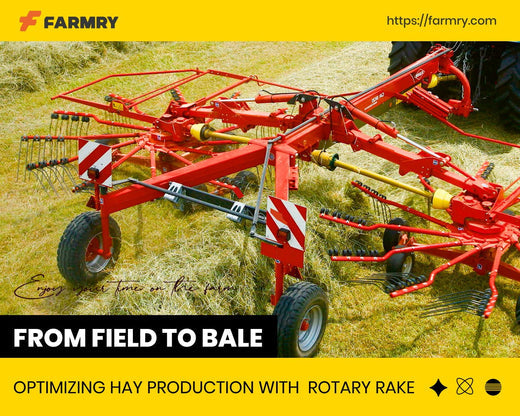
For rotary or PTO-driven hay rakes, use the stated working width, not shipping width or overall machine dimensions.
Adjustability is especially useful because it gives the operator more flexibility as crop conditions change.
The Farmry RK98, for example, publishes a 98-inch working width and allows windrow width adjustment, which can help match the finished row to different baler or moisture conditions.
Disc Mower vs. Mower Conditioner: Crop Volume Still Matters
A standard disc mower cuts forage but does not condition the crop.
A mower conditioner adds conditioning rolls or another conditioning system that helps stems release moisture and can reduce drying time, particularly in heavier or stemmy forage.
That difference affects the overall harvest plan.
A disc mower is generally a simpler and more economical cutting machine, while a mower conditioner can be useful when drying time is a major concern.
Regardless of mower type, the rake still needs to create a windrow that works with the baler.
A wide swath can improve exposure to air and speed drying, but before baling, the crop still has to be gathered into a controlled windrow.
A tedder can also be part of the system when additional spreading and drying are needed before raking.
Don't Ignore Mowing Setup When Matching Equipment
Correct width matching will not compensate for poor mowing setup.
Before mowing:
-
Inspect the field for rocks, wire, holes, debris, and other hazards.
-
Inspect disc mower knives for excessive wear or damage.
-
Maintain the required PTO speed; 540 RPM is standard for many tractor disc mowers.
-
Maintain roughly 5–10% overlap between mowing passes when needed to avoid uncut strips.
-
Set cutting height according to the forage and field.
Typical cutting-height planning ranges include:
-
Alfalfa: approximately 2–3 inches.
-
Cool-season grasses: approximately 3–4 inches.
-
General forage: often around 2–4 inches depending on crop and management goals.
Cutting too low can increase soil contamination and compromise regrowth and stand longevity.
A slightly higher cutting height can also leave more airflow beneath the cut crop, which can help drying.
One important point about RPM: the tractor PTO may operate at 540 RPM while the mower's internal discs and blades rotate much faster. Do not confuse cutter-disc speed with required tractor PTO speed.
Always follow the mower's operator's manual.
Can a 98-Inch Hay Rake Match Both a 65- and 81-Inch Disc Mower?
Yes—for single-swath coverage, a 98-inch rake can be wide enough to work behind either a 65-inch or 81-inch disc mower.
But that is different from asking whether the rake can gather two mower passes at once.
With a 65-Inch Mower
-
Mower width: 65 in.
-
Rake width: 98 in.
-
One mower pass: Yes.
-
Two full mower passes in one rake pass: Not a reliable width match; approximately 130+ inches of coverage would be the planning target.
With an 81-Inch Mower
-
Mower width: 81 in.
-
Rake width: 98 in.
-
One mower pass: Yes.
-
Two full mower passes in one rake pass: No; approximately 162+ inches would be the planning target.
So the 98-inch rake should be viewed as a rake capable of working with either mower, but not as a two-swath rake for those mower widths.
That distinction can prevent an expensive buying mistake.
Match Tractor Requirements Too
Width is only part of compatibility.
Before purchasing either machine, confirm:
-
Tractor engine horsepower.
-
PTO horsepower.
-
PTO speed.
-
3-point hitch category.
-
Rear lift capacity.
-
Implement weight.
-
Tractor stability.
-
Hydraulic requirements, if any.
-
PTO driveline fit.
-
Field terrain.
Disc mowers create a side load because much of the machine extends away from the tractor. The tractor therefore needs enough weight and stability—not simply enough horsepower—to carry and operate the mower safely.
Farmry currently lists the 65-inch DHM6 for 35–80 HP tractors and the 81-inch DHM7 for 35–85 HP tractors. Both are listed for Category I/II tractor applications.
By comparison, the RK98 page publishes an 18–25 HP requirement, Category I hitch, and 540 RPM PTO specification.
Because those published tractor-power ranges differ, do not assume that one tractor is automatically approved for a specific mower-and-rake combination. Confirm the allowed tractor specifications for each implement individually before ordering or operating it.
A Simple Buying Checklist
Before buying a disc mower, hay rake, or baler, write down these five numbers:
1. Disc mower cutting width
Example: 65 or 81 inches.
2. Expected laid swath width
A disc mower may leave approximately 75–90% of its cutting width as a crop swath.
3. Number of mower swaths per windrow
Choose one, two, or three based on crop density and baler capacity.
4. Hay rake working width
It must cover the mower passes you intend to gather.
5. Baler pickup width
The finished windrow should fit within the usable pickup width.
Then consider the conditions that numbers alone cannot describe:
-
Heavy crop or light crop?
-
Grass hay or alfalfa?
-
Wet hay or dry hay?
-
Flat ground or rough ground?
-
A few acres or larger open acreage?
-
Straight fields or irregular corners?
-
How much drying time does your weather window allow?
A matched hay system is not simply a mower, rake, and baler that can all attach to a tractor. It is a sequence of machines that can cut, dry, gather, and feed the crop at compatible widths and capacities.
FAQs
1. Does a hay rake need to be wider than the disc mower?
Usually, the rake's effective working width should at least cover the mower swath with some operating margin. If you want to gather two mower passes in one rake pass, the rake normally needs substantially more working width than the mower itself.
For planning purposes, combining two mower swaths generally requires roughly twice the mower cutting width plus some allowance.
2. Should one rake pass collect one or two mower swaths?
It depends on crop density and baler capacity.
In heavy first-cutting hay, combining two swaths may already create enough crop volume for the baler. In light crop, combining more swaths can make a fuller and more consistent windrow.
Do not choose the number of swaths based on rake width alone. The resulting crop volume must also remain manageable for the baler.
3. How should windrow width match the baler pickup width?
The finished windrow should match or slightly underfill the usable width of the baler's pickup teeth.
Do not confuse rake working width with finished windrow width. A rake may gather crop across 130 inches or more of field width and then place that crop into a much narrower windrow for baling.
Always check the baler's operator's manual for its usable pickup specification.
4. Can a 98-inch hay rake work behind a 65- or 81-inch disc mower?
Yes, a 98-inch working-width rake can cover a single pass from either a 65-inch or 81-inch disc mower.
However, it should not be considered wide enough to reliably combine two complete mower passes into one windrow in a single rake pass. Two 65-inch passes represent roughly 130 inches of cutting width, while two 81-inch passes represent roughly 162 inches.
For a two-swath-per-pass system, choose the rake according to that larger required gathering width.
5. Can the same tractor safely operate both the disc mower and hay rake?
Yes, but only when the tractor meets the specifications of both implements individually.
Check tractor horsepower, PTO horsepower, PTO speed, 3-point hitch category, lift capacity, implement weight, PTO shaft compatibility, and tractor stability.
Do not assume that a tractor suitable for the disc mower is automatically approved for the rake—or vice versa. If the manufacturers publish different tractor power ranges, confirm compatibility before operating the combination.