Skip to content



What Size Hay Mower for Small Tractor? Match Tractor HP, PTO Speed, and Cutting Width
 Buying a hay mower for a small tractor sounds simple until three numbers start competing for your attention: tractor horsepower, PTO horsepower, and cutting width.
That is where small farmers often get caught. A mower may technically connect to the 3-point hitch yet demand more PTO power than the tractor can comfortably supply. Another may have manageable horsepower requirements but put too much weight off one side of a very small tractor. And going wider just to make fewer passes does not always make hay production faster if the tractor struggles whenever the crop gets heavy.
The better approach is to match the whole machine—not just the horsepower number on the hood.
The short answer: match PTO, weight, and width together
For small-farm hay work, these are useful starting points based on current Farmry specifications:
|
Tractor range |
Practical mower example |
Cutting width |
PTO speed |
Implement weight |
Where it makes sense |
|---|---|---|---|---|---|
|
15–20 HP tractor range |
Farmry DM42 drum mower |
42 in. nominal; 39.4 in. listed cutting width |
540 RPM |
351 lb |
Very small tractors, tight spaces, smaller acreage |
|
25–40 HP tractor range |
Farmry DM53 drum mower |
53.1 in. |
540 RPM |
399 lb |
Small farms wanting more ground covered per pass |
|
35–80 HP tractor range |
Farmry DHM6 disc mower |
65.1 in. |
540 RPM |
1,080 lb |
Heavier tractors and higher-capacity hay work |
|
35–85 HP tractor range |
Farmry DHM7 disc mower |
81.4 in. |
540 RPM |
1,168 lb |
More acreage where wider cutting is worth the extra weight |
The current Farmry DM42 drum mower is specified for 15–20 HP tractors, a 540 RPM PTO, and a 351-pound machine weight. The DM53 drum mower moves up to a 53.1-inch cut, 25–40 HP tractor rating, 540 RPM PTO, and 399-pound machine weight.
Once you move into Farmry’s disc mower range, the power and weight jump substantially. The 65-inch DHM6 is listed for 35–80 HP tractors, runs at 540 PTO RPM, and weighs 1,080 pounds.
That weight difference matters just as much as the extra cutting width.
Do not confuse engine horsepower with PTO horsepower
A tractor advertised as “25 HP” does not necessarily deliver 25 HP to the mower.
Some power is consumed before it reaches the rear PTO. A current John Deere 1025R illustrates the difference clearly: Deere lists 24 engine HP but only 18 rated PTO HP, with a 540 RPM rear PTO.
That means a farmer who owns a roughly 24 HP John Deere should not automatically assume every implement advertised for “20–25 PTO HP” is a comfortable match.
This is why the first number to find in your tractor manual should be rear PTO horsepower, whenever the implement manufacturer specifies PTO HP.
If the mower instead specifies a general tractor horsepower range, use that manufacturer's specification—but still check PTO speed, machine weight, hitch geometry and lift capacity separately.
A simple rule is worth remembering:
Engine HP tells you about the tractor. PTO HP tells you how much usable power is available to the implement.
PTO speed is not a setting to improvise
Most compact hay equipment in this class is designed around a 540 RPM rear PTO.
Both Farmry compact drum mowers above specify 540 RPM. The Farmry DHM6 and DHM7 disc mowers also specify 540 RPM.
Do not think of PTO speed as “the faster I spin it, the better it will cut.” The gearbox, blade or drum speed, driveline and protective components are designed around a particular PTO input.
Run the mower at the PTO speed specified by its manufacturer and use the corresponding tractor engine RPM indicated in your tractor manual.
That becomes particularly important with a disc mower. Farmry's DHM6, for example, takes a 540 RPM PTO input and turns its four cutting discs at a listed 2,623 RPM. The gearbox is doing the work of converting PTO input into effective blade speed; the operator should not try to create extra blade speed by overspeeding the PTO.
Sickle bar mower, drum mower or disc mower?
The right mower is partly a horsepower decision and partly a decision about your ground, crop and tractor.
|
Mower type |
Strong fit for |
Power character |
Main trade-off |
|---|---|---|---|
|
Sickle bar mower |
Very small or lower-powered tractors, light hay, narrow access |
Can work with modest horsepower |
More sensitive to setup, crop conditions and obstructions |
|
Drum mower |
Compact tractors, small farms, grass hay, practical general hay production |
Modest power requirement for its cutting ability |
Heavier than the lightest sickle arrangements |
|
Disc mower |
Higher production, dense hay, wider fields |
Higher power and substantially more implement weight |
May exceed the practical limits of very small tractors |
When a sickle bar mower still makes sense
The sickle bar is old technology in the complimentary sense: it has survived because it can do useful work without enormous power.
Current Sitrex sickle bar models provide a good example. Its 5-foot-6-inch, 6-foot and 7-foot machines are all listed at 15 HP required and 540 PTO RPM. Machine weights range from roughly 485 to 530 pounds.
That makes the sickle bar mower worth considering when the tractor has limited power but enough hitch and stability capacity for the mower.
A sickle bar cuts with reciprocating sections rather than high-speed rotating discs. It can be attractive for a very small tractor and for farmers who value low power demand more than maximum field speed.
The trade-off is that mowing performance depends heavily on knife condition, adjustment and crop conditions. Lodged hay or difficult material can make correct setup particularly important.
Why a compact drum mower hits a useful middle ground
For many small farmers, a compact drum mower sits in the sweet spot between a traditional sickle bar and a much heavier disc mower.
A drum mower uses counter-rotating drums with cutting blades. Farmry's DM42 and DM53 both use two counter-rotating drums and are designed to place the cut crop into strips for the next stages of haymaking.
The appeal is straightforward: you can get a rotary cutting system without immediately jumping into a 1,000-plus-pound disc mower.
For someone with a very small tractor, the 351-pound DM42 versus the 1,080-pound DHM6 is not a minor specification difference. It changes the entire tractor-implement relationship.
Farmers working small fields, awkward corners or tight spaces may find that manageable size gives them a better job overall than buying the widest mower the engine can theoretically pull.
You can compare the current sizes in Farmry's drum mower collection.
When a disc mower earns its extra weight
Disc mowers use multiple rapidly rotating discs, each carrying cutting blades. Their attraction is production: wider cutting widths and fast cutting action allow a capable tractor to cover more ground with fewer passes.
Farmry currently lists disc mowers at 65, 81, 95 and 111 inches. The smaller DHM6 starts at a listed 35 HP tractor requirement, while the wider models move into higher horsepower ranges.
This is where chasing cutting width can get a small tractor owner into trouble.
The DHM6 may only be roughly a foot wider than the DM53, but it is about 681 pounds heavier. That is a large change in rear and side-mounted load.
A bigger mower therefore needs a bigger tractor relationship, not merely more engine power.
Can a 25 HP compact tractor really cut hay?
Yes. A 25 HP compact tractor can be a perfectly useful hay tractor when it is paired with equipment designed for that size.
But the words “25 HP tractor” are not enough to choose the mower.
Imagine two owners each describing their machine as a 25-horsepower tractor. One may have around 18 PTO HP and weigh roughly 1,500 pounds. Another may deliver more PTO power, carry substantially more chassis weight, and have greater 3-point lift capacity.
Those tractors should not automatically run the same mower.
For a tractor around this size, a compact drum mower is often a much more realistic place to begin than a heavy side-mounted disc mower. Farmry's DM53, for example, is specifically listed for 25–40 HP tractors and weighs 399 pounds.
By comparison, Farmry's smallest current disc mower is more than 1,000 pounds and begins at a 35 HP tractor rating.
So the answer is not “25 HP is too small.”
It is: 25 HP is enough for some real hay equipment, but not for every hay mower.
Cutting width: wider is useful only when your tractor can carry it
There is an understandable temptation to buy the widest mower possible. More width means fewer passes, less time crossing the same field and potentially more acres cut during a good weather window.
But cutting width should come after compatibility.
A wider machine normally brings more weight and potentially greater power demand. It can also be harder to maneuver around gates, trees, fence lines and irregular fields.
For a small farm, giving up a little width can actually make mowing easier because the tractor remains stable and responsive instead of operating close to its limits.
This is particularly important on sloping or rough ground. Flat ground is much more forgiving than a hillside when a mower puts substantial weight to one side of the tractor.
Before moving up a width, check:
-
rear PTO horsepower and specified PTO speed; 3-point hitch compatibility and lift capacity; implement operating and transport weight; recommended ballast and tractor minimum weight; hydraulic connections if the mower uses them; tire spacing and stability; field slope, holes, rocks and obstacles; and whether the mower can clear the tractor's rear tires correctly.
Horsepower alone cannot answer those questions.
Tractor weight may stop you before horsepower does
This is the part of mower shopping that deserves more attention.
A lightweight tractor can have enough engine power to turn a mower while still being a poor platform for carrying it safely.
The 24 HP John Deere 1025R, for example, has a listed base machine weight of 1,556 pounds. A Farmry DHM6 disc mower weighs 1,080 pounds.
That comparison is not a fitment recommendation—the DHM6 itself calls for a substantially higher tractor horsepower range. It simply demonstrates why implement weight cannot be treated as an afterthought.
With any side-mounted mower, think about what happens when you raise the machine for a turn or transport it rather than considering only what happens while it is cutting on flat ground.
Consult the tractor manual for 3-point lift limits, ballast instructions and operating restrictions, and follow the mower manufacturer's setup procedure. Keep the PTO shielding and mower guards in place and keep people and animals well away from the cutting area.
Think about the whole hay system before choosing the mower
The mower is only the first machine in hay production.
Once the grass is cut, you still have to get the crop dry enough, rake it into a windrow that your baler can pick up cleanly, and turn it into a bale that suits your feeding, storage and handling system.
That means the smartest small-farm equipment package is not always the widest mower your tractor can run. It is the combination of mower, tedder or rake, and baler that one tractor can operate effectively.
Do you need a tedder?
Not on every field and not every cutting.
A tedder spreads and turns loose hay so more of the crop is exposed to air. That can be valuable when forage is heavy, the ground is holding moisture or the weather window for baling is tight. Sitrex likewise describes tedding as part of the haymaking process used to optimize forage quality before raking and baling.
In dry conditions with light grass, a farmer may be able to mow, allow sufficient drying and rake without adding another pass.
Think of a tedder as a drying-management tool rather than something you automatically need simply because you own a hay mower.
Your hay rake needs to match the baler, too
The rake controls the windrow that eventually reaches the baler pickup.
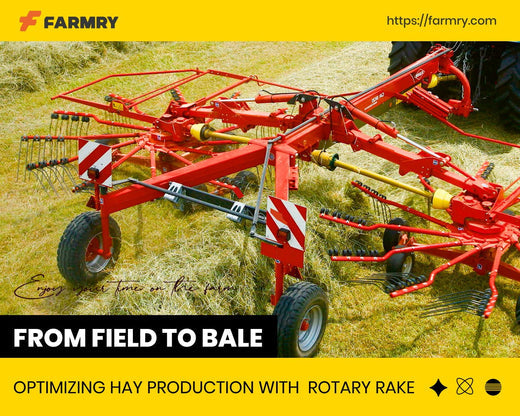
Farmry's current RK98 is a 98-inch PTO hay rake for 18–25 HP tractors, with a 540 RPM PTO requirement and a Category I 3-point hitch. Farmry describes the rake as creating uniform windrows for baling and allowing working-width adjustment to suit different baler setups.
Farmry's guide to hay rake types also distinguishes wheel rakes, rotary rakes and other designs. Wheel rakes are ground driven and emphasize speed and productivity, while rotary rakes use a powered sweeping action to make controlled windrows.
You can also compare Farmry's current hay rake equipment.
The important measurement here is no longer mower cutting width—it is windrow width versus baler pickup width.
Can the same small tractor run a mini round baler?
Sometimes, yes. But once again, read more than the horsepower number.
A compact mini round baler can be designed for surprisingly modest tractors. One current Ibex TX31 example listed by Tractor Tools Direct uses a 540 RPM PTO and specifies a 15 HP minimum engine power, but the baler itself weighs 976 pounds and calls for a minimum 1,500-pound tractor. Its bales average about 30–50 pounds.
That reveals a useful distinction that is often misstated online: the 40–55-pound figure associated with mini round hay equipment normally refers to the bale, not the mini round baler itself. Tractor Tools Direct's broader buyer guide likewise describes mini round bales at roughly 40–55 pounds and says they can usually be lifted by one person.
Pickup width matters, too. Small round balers may have relatively narrow pickups, which means your wheel rake or rotary rake needs to make a compatible windrow. Gathering wheels can expand effective pickup width and reduce the amount of hay left outside the pickup path.
For farmers choosing between twine and net wrap, net wrap can also shorten the wrapping cycle because the bale needs fewer rotations during wrapping; Tractor Tools Direct reports production improvements of 25% or more for its compact-baler context.
What about a small square baler?
This is where PTO horsepower can become the limiting factor.
“Square baler” covers a wider range of machines than many first-time hay farmers expect. John Deere's 338 and 348 small square balers, for example, list 35 PTO HP requirements, while Deere's current S200 specification is higher at 59 PTO HP.
Compact European-style square balers can be different. The current Sitrex listing for the Abbriata M60 Super specifies 20–25 PTO HP, a 54-inch maximum pickup width, and hay bales of approximately 39–62 pounds. Its stated production capacity is 3–9 bales per minute.
This also gives some useful context to figures sometimes quoted for Abbriata balers. Older material has cited operation from 16 PTO HP, while current product and distributor information commonly lists about 20 PTO HP for current compact square-baler configurations. Treat the exact minimum as model-specific and needs verification from the current manual, rather than assuming every Abbriata baler will run at 16 PTO HP.
For a small farmer, that difference can determine whether the tractor used to mow can also handle the baler—or whether baling is the job that finally requires a bigger tractor.
How many acres can you mow in a day with a small tractor?
The realistic answer depends on much more than cutting width.
Crop density, lodged hay, flat versus rough ground, turning space, travel speed, overlap, blade condition, field shape and time spent clearing obstructions all change the result.
Manufacturer capacity figures are useful as an upper reference rather than a guarantee.
Farmry lists the DM42 at up to 1 hectare, or about 2.47 acres, per hour. The wider DM53 is listed at up to 1.35 hectares, or about 3.34 acres, per hour.
At six actual mowing hours, those published capacities would mathematically correspond to roughly 15 acres for the DM42 and 20 acres for the DM53. Real fields will often come in below a nameplate figure because you are not cutting at full working speed every minute of the day.
For a five-acre or ten-acre small farm, this is an important perspective. You may save more money and frustration by choosing a mower your existing tractor handles comfortably than by buying extra cutting width for a theoretical productivity gain you rarely need.
A practical mower-sizing decision
If I were sizing hay equipment for a small tractor, I would work backward from the tractor rather than forward from the mower catalog.
Find the rear PTO horsepower. Confirm whether it is 540 RPM. Check the tractor's weight and 3-point lift specification. Then look at the field: acreage, slopes, rough ground, gates and the type of hay you expect to cut.
From there:
A very small or older tractor with limited power may make a sickle bar mower worth serious consideration.
A small compact tractor working modest acreage is where a compact drum mower becomes particularly interesting because it combines rotary cutting with relatively modest horsepower requirements.
A heavier compact or utility tractor with enough power, lift capacity and stability can move into a disc mower when covering more ground in less time matters enough to justify the additional machine weight.
Then make sure your rake and baler fit the same system.
The goal is not to own the biggest mower your tractor can barely operate. The goal is to put hay in the barn with equipment that works together without turning every cutting into a fight between the tractor and the attachment.
For current sizing options, start with Farmry's hay equipment collection, then compare the compact drum mowers with the heavier disc mower lineup.
Editorial note: Product specifications and Farmry internal links were checked on August 12, 2026. Tractor and implement specifications can change. Always verify the current tractor manual, mower operator's manual, PTO rating, hitch compatibility, lifting capacity, ballast requirements and safety instructions before purchasing or operating hay equipment.